
Duobblon Uranium Project
Overview
A drill-defined uranium deposit on European soil — a historical ~8.75 Mlb U₃O₈ (non-compliant estimate)1, open at depth and along strike. Strategic pounds as Europe and the West move to secure domestic and allied uranium supply.
At a Glance
Location
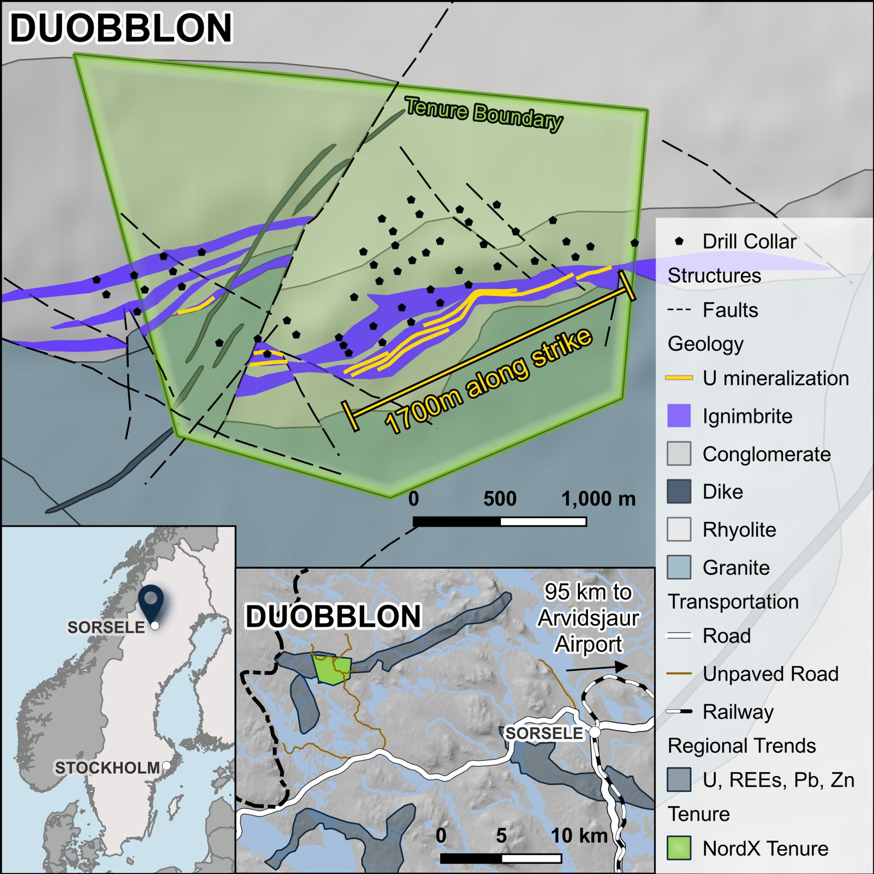
~30 km WNW of Sorsele, Västerbotten County (Lapland), northern Sweden
Tenure
Exploration permit BS 200-583-2022, ~630 ha (granted/valid to 2029)
Ownership
100%, via Swedish Minerals AB
Commodity
Uranium — volcanic-/ignimbrite-hosted
Deposit Style
Volcanic-hosted (volcanogenic) uranium — disseminated uraninite/pitchblende in welded ash-flow tuff
Historical Drilling
53 holes for ~10,300 m (SGU, 1976–1980); core preserved
Access
Road and power; a single landowner over the entire tenement
Stage
Historically drilled; historical non-compliant estimate; open at depth and along strike
Why It Matters
Duobblon is a rare opportunity at the exploration stage: a uranium body already drilled at scale, with much of the core preserved for re-sampling and historically positive metallurgy, on infrastructure-rich ground with a single landowner — a re-sampling and resource-definition story, not a grassroots hunt.
Two things sharpen the case. It is a call option on a higher uranium price — a large, low-grade, already-drilled body that gives leverage to the uranium market, with the pounds in the ground awaiting price and modern definition. Additionally, it is strategically placed for Europe — sizeable, drill-defined uranium on EU soil, at a moment when the EU and its allies are moving to secure domestic and non-Russian uranium supply under the Critical Raw Materials Act.
The Story
Duobblon was found and drilled by the Geological Survey of Sweden (SGU) between 1976 and 1980 — a state uranium program that put 53 holes and over 10,300 m into the deposit and calculated a first (Lindroos, 1979) ore estimate. In the last uranium cycle, Mawson Resources (2004–2011) relogged and check-sampled the core and published a 2008 estimate. The ground then passed to Swedish Minerals AB and into the NordX portfolio in January 2026.
Geology & the Target
Duobblon is a volcanic-hosted (volcanogenic) uranium system: disseminated, stratabound uraninite and pitchblende within two welded ash-flow tuff (ignimbrite) horizons, typically 5–25 m thick, from 3 m to 300 m vertical depth. Mineralisation is open at depth and along strike — the estimate captures the drilled envelope, not the limit of the system. The near-term work is modern re-sampling and resource definition of a body that is already extensively drilled, rather than a search for a discovery.
Important Considerations
- Historical, non-compliant — the estimates and metallurgy predate, and do not comply with, current standards; a Qualified Person has not treated them as current resources, and they should not be relied upon.
- Low grade / price-levered — Duobblon is a large, low-grade body; its value is geared to the uranium price and to modern definition, not to grade.
- This is an historical estimate (within the meaning of NI 43101) and is not a current mineral resource or mineral reserve. A qualified person has not done sufficient work to classify this historical estimate as a current mineral resource or mineral reserve and the Company is not treating the historical estimate as a current mineral resource or mineral reserve. The historical estimate should not be relied upon. The historical estimate is derived from Browne, A., 2008: REPORT ON CURRENT RESOURCE ESTIMATES FOR KLÄPPIBÄCKEN AND DUOBBLON URANIUM PROPERTIES, AND REVIEW OF TÅSJÖ URANIUM PROJECT, NORTHERN SWEDEN, prepared for Mawson Resource Limited