
Asento Uranium Project
Overview
An AREVA-discovered uranium boulder field — first assays in hand, advancing toward its maiden drill test — in Finnish Lapland.
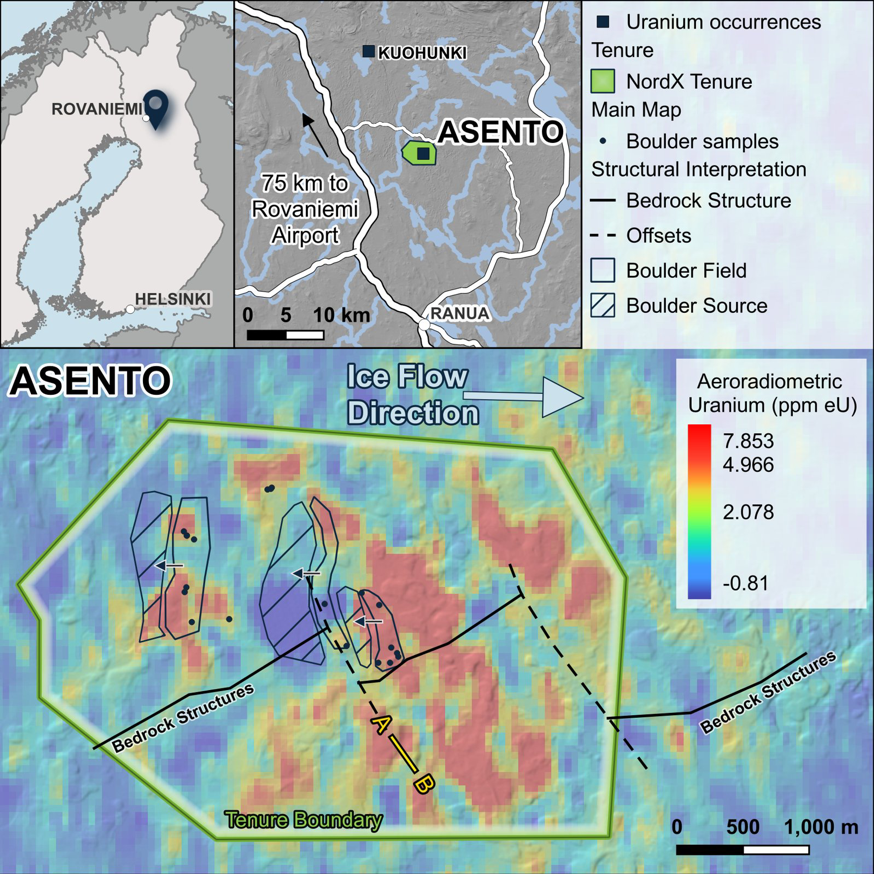
At a Glance
Location
Portimojärvi, Ranua / Rovaniemi, Lapland, Finland — ~55 km SE of Rovaniemi
Tenure
Exploration permit ML2024:0081 “Asentolamminoja 1”, ~1,203 ha in force (granted 2025; valid to 2029)
Holder
Swedish Minerals AB (a NordX subsidiary)
Commodity
Uranium (U > Th; minor copper)
Deposit Style
Albitite / metasomatic (sodium-metasomatic) uranium in Archaean basement
Prior Operators
AREVA (now Orano) — discovered and reserved the ground in 2007
Stage
Boulder-prospecting; never drilled; maiden drill programme planned Q4 2026 / Q1 2027
Why It Matters
A large, AREVA-discovered radioactive boulder field — with shallow cover and a short, locally-derived glacial trail pointing back to a findable bedrock source — that is now moving from surface work into its first drill test. First laboratory assays confirm uranium in the boulders; a systematic soil program has been completed, and a maiden drill program is being planned.
The Story
In 2007, AREVA — then the world’s largest uranium producer — was running a Finnish uranium campaign off the back of GTK’s airborne radiometric surveys. A strong uranium anomaly in the Archaean basement southeast of Rovaniemi drew the company in, and it reserved the Asentolamminoja ground and mapped a ~3 km × 3 km radioactive glacial-boulder field — nicknamed the “10,000 boulders” in the peer-reviewed literature (Lauri & Turunen, 2015). AREVA ran preliminary surveys and geophysics but — as the 2000s uranium cycle faded — never drilled the bedrock source, and the old-law claims lapsed. NordX has since reconsolidated the ground, holds a granted exploration permit over the boulder-field core, and is actively working it.
Geology & the Target
Asento sits in Archaean Pudasjärvi/Ranua-complex basement, near the contact with the overlying Palaeoproterozoic Peräpohja belt. The uranium is Proterozoic in age (uraninite U-Pb ≈ 2,000–2,100 Ma) despite the Archaean host — introduced long after the granitoid formed — which GTK documents as metasomatic / hydrothermal uranium (a sodium-metasomatic, albitite-type system, uranium-dominant, U > Th), with a copper (chalcopyrite) association.
The key to the target is the boulders. Quaternary studies show the radioactive boulder field is of local origin — transported only ~50–200 m by ice — so the bedrock source is close, up-ice to the west, and findable. The exploration logic is direct: trace the locally-derived float up-ice with till and geophysical surveys, map the albitisation and structure, and drill the source.
Results to Date
Early-stage figures — historical and current surface work, non-compliant, not a mineral resource.
- First laboratory assays (NordX news release, 30 June 2026): 20 boulder samples returned 0.005–0.213% U₃O₈ (average 0.081%, median 0.0665%) — confirming widespread uranium in the boulder field.
- Handheld gamma-spectrometer readings to ~9,500 cps in-sample, uranium over thorium, with secondary-uranium minerals observed — counts, not a grade.
The Program — What’s Next
The centre of the target is not dormant. NordX has a funded, staged program:
- Phase-1 soil sampling (~350 samples) complete — vectoring toward the bedrock source.
- Drone radiometric / magnetic survey planned for Q3 2026.
- Maiden drill program expected in Q4 2026 / Q1 2027.
The Ranua area is a road- and power-accessible, permitted mining district — the Suhanko palladium-platinum-nickel-copper development (a third party) lies nearby, evidence of district infrastructure and a workable permitting pathway.
Important Considerations
- Float is not bedrock — the boulder and radiometric figures are on glacial float and handheld readings; they are not in-situ grades and are not convertible to a resource.
The source is interpreted, not proven — the up-ice/western bedrock source is an interpretation from Quaternary studies; it is undrilled and untested.
Early-stage — the program timing and outcomes are plans and are not assured; historical and surface results are not a guarantee of future results.