
Kovela REE Project
Overview
A drilled, high-grade monazite-granite rare-earth occurrence with a small historical, non-compliant estimate — in southern Finland.
At a Glance
Location
Lohja (Nummi area), southern Finland
Tenure
~216 ha
Ownership
100%, via Swedish Minerals AB
Commodities
Rare-earth elements + uranium (± thorium)
Deposit Style
Monazite granite (REE–U–Th) — a GTK-drilled occurrence with two narrow, shallow mineralised zones
Stage
Historical non-compliant estimate; GTK-drilled (two shallow zones); early-stage
Why It Matters
Two GTK-drilled monazite-granite zones plus surface outcrops — on road- and power-served ground in southern Finland.
Geology & the Target
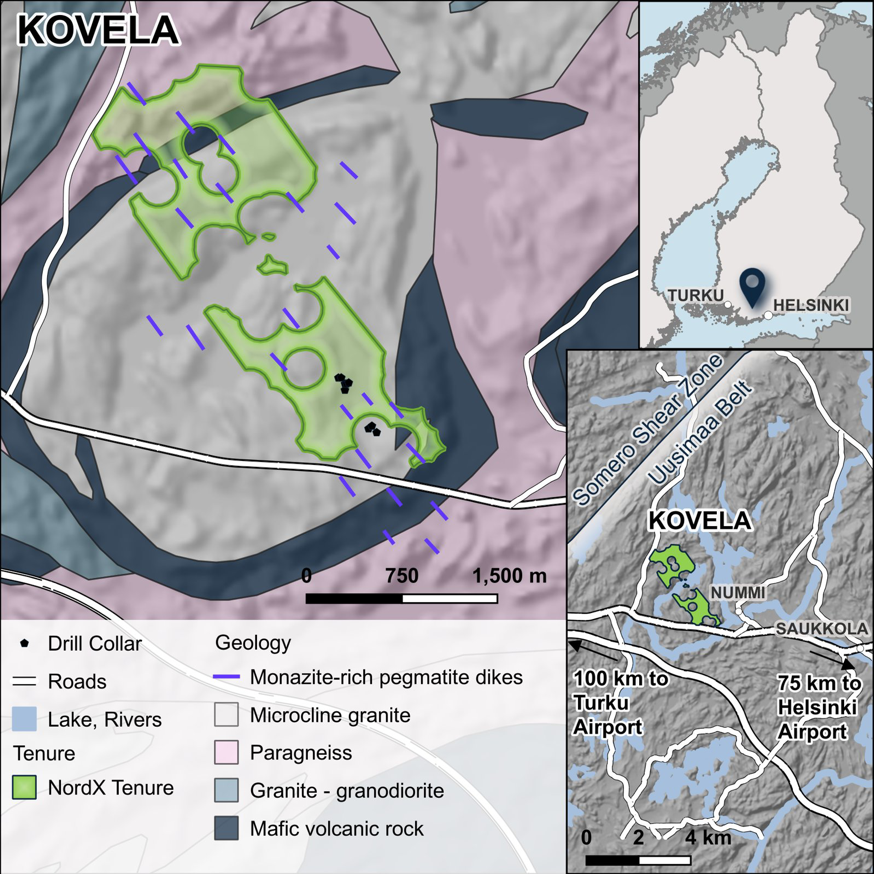
Kovela is a monazite-granite rare-earth system: REE — with uranium and thorium — carried in a late-orogenic monazite-bearing granite, drilled and modelled by the Geological Survey of Finland (GTK), which built a 3-D model in 2014. Two narrow, shallow mineralised zones (SE and NW, ~380 m apart) were drilled from about 21.5 m and 38 m downhole; two radioactive surface outcrops sit within the granite footprint.
Project Highlights
- A small historical (non-compliant) estimate — 99,000 t at 1.362% REEOx (GTK MDaE 2025 oxide restatement of GTK 57/2014’s two zones: SE 82,000 t @ 1.0% + NW 17,000 t @ 2.0% REEtot).
- High-grade and shallow — best drill grade ~4.3% REEtot over 2 m (peak 2 m interval, not a true width), with by-product uranium (to ~491 ppm U), from about 21.5 m and 38 m downhole.
- Well positioned — road and power access.
Basis note: The estimate is historical and non-compliant (an NI 43-101 historical estimate), disclosed by a prior party, not independently verified by NordX, and not a current mineral resource. It should not be relied upon.
Prior Work
- 1974–1985 — Finnish state prospecting: regional and detailed geophysics and geochemistry, detailed geology, percussion drilling, and ore-beneficiation test work.
- 2010–2012 — Geological Survey of Finland (GTK): core drilling.
- 2013 — GTK: rare-earth potential investigation.
- 2014 — GTK: historical mineral-resource estimate and 3-D model.
- 2014–2016 / 2022–2024: held by private parties before consolidation into the NordX portfolio.